Fairway
Score a round together, even when you are holes apart.
Group scoring apps assume everyone is standing on the same tee. Real golf does not work like that — you are on the 7th, the pair behind you is on the 3rd, and somebody joined at the turn. Fairway is built around that from the ground up: there is no shared turn, nobody advances the group, and no one waits.
How it works
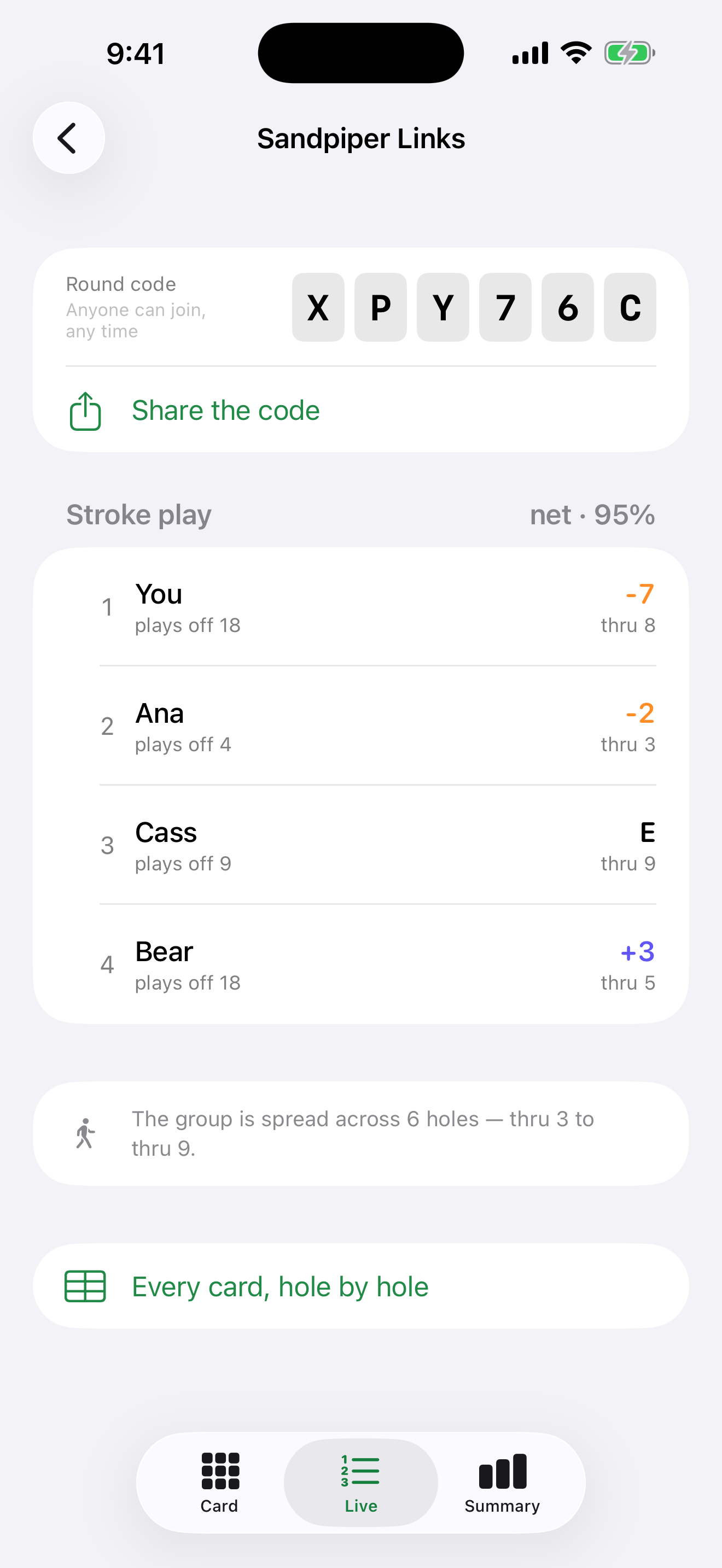
- Start a round, share the code. Six characters, read out across a tee box or texted to the group — XPY76C. Anyone can join with it, at any point in the round.
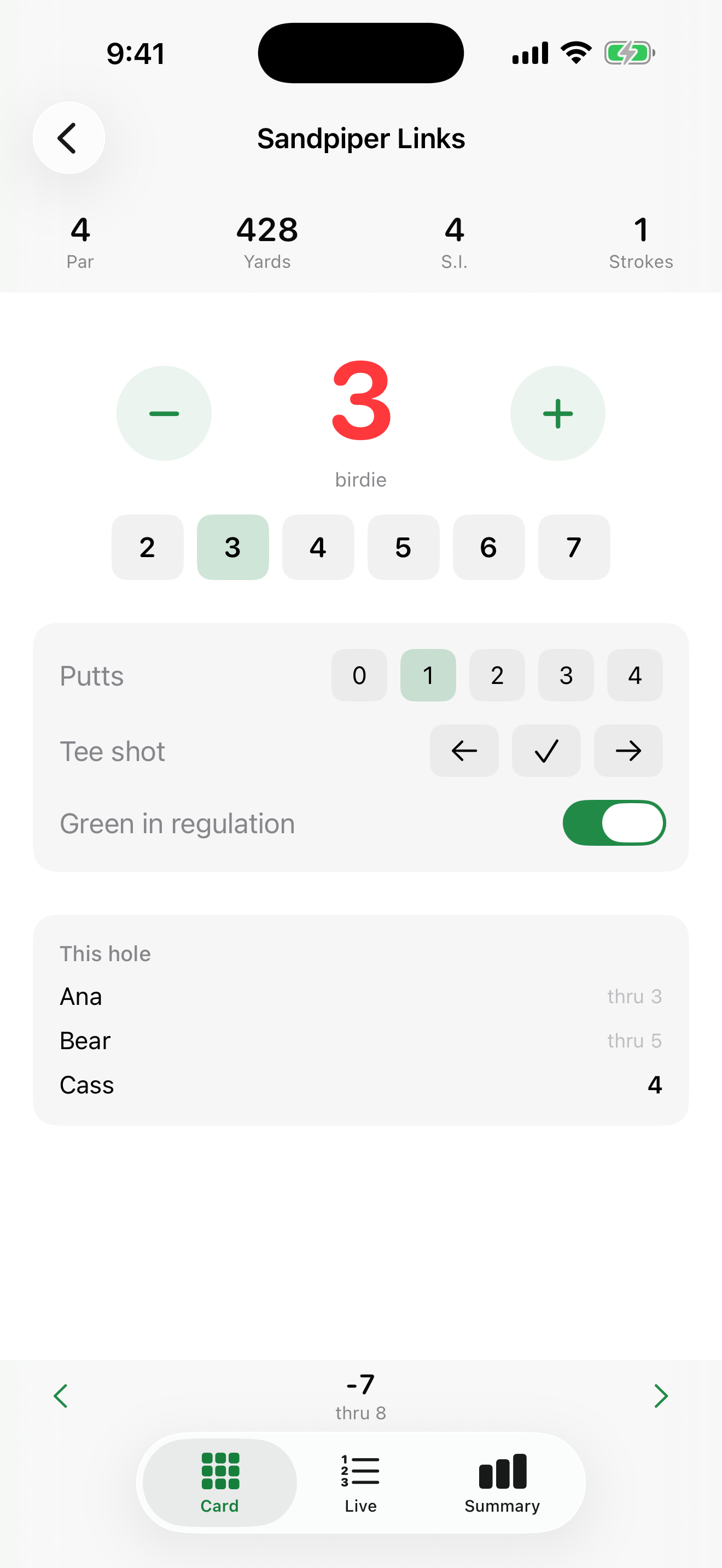
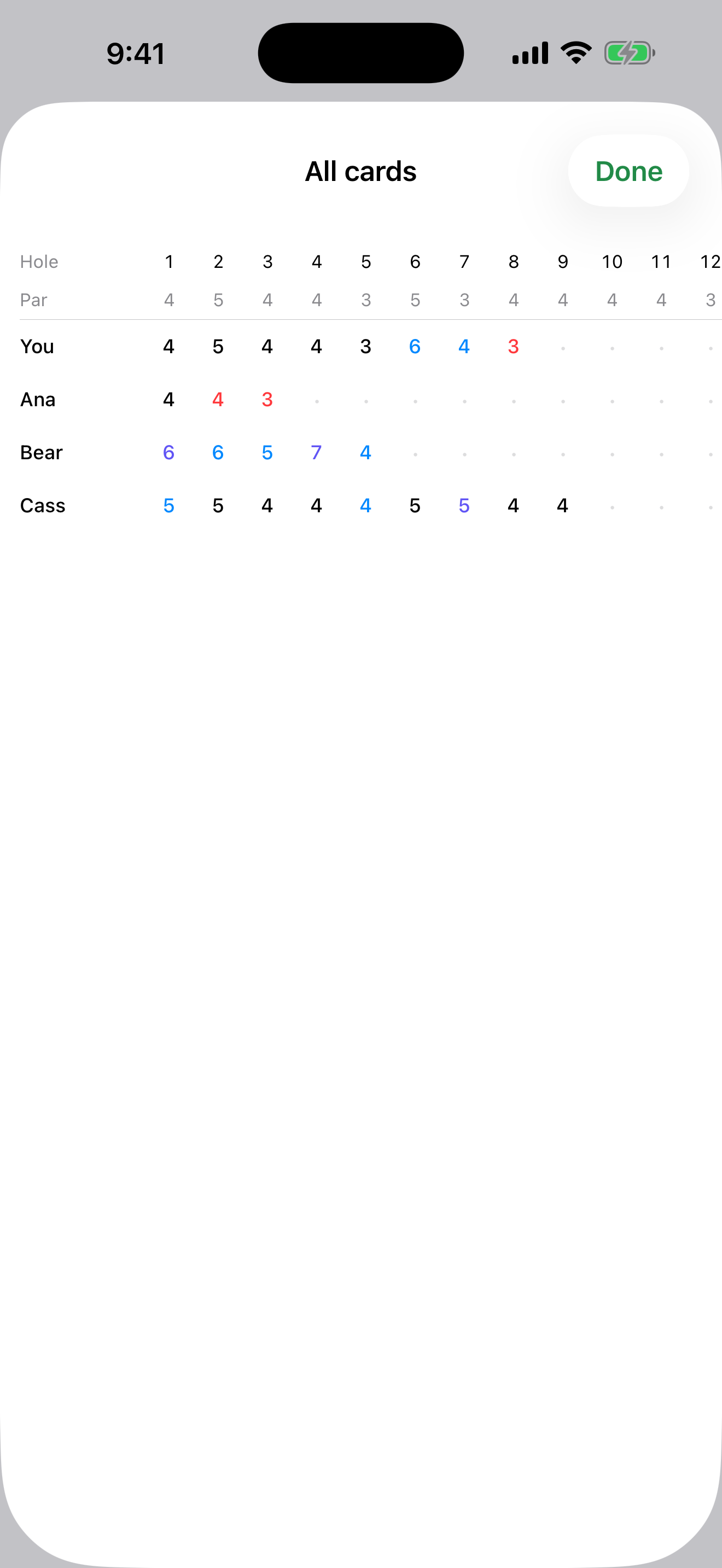
- Join on the 14th if that is where you are. You get a card starting on the hole you are standing on. The holes behind you stay blank, and they are excluded from every comparison rather than counted as zeroes.
- Nobody is behind for teeing off late. Match play, skins and head-to-head run over the holes both sides have actually finished. A player thru 12 against a player thru 3 is level after three — not nine up.
- Every row says "thru". A score without that context is meaningless when a group is spread over the course, so it is never hidden.
Real courses, real numbers
Search 32,000 courses by name and pick your tee. Par, stroke index and yardage come from the published scorecard; course rating and slope come from the tee you chose, split by gender where the course publishes both. That is what turns a handicap index into strokes on this course, allocated to the holes the stroke index says — not spread evenly and not guessed.
Every format, scored properly
- Stroke play, gross and net.
- Stableford, standard and modified — where one blow-up costs you a hole rather than the round.
- Match play, with dormie and a proper close-out: 3&2, not "3 up with 2 to play".
- Skins, where a halved hole carries and doubles what the next one is worth. A hole is only settled once everyone has played it — two players tied on 4 is not a tie if a third is still over a putt for 3.
- Team formats — best ball, best two, aggregate, scramble and alternate shot. Four-ball compares partners on net, because an 18-handicap's net 4 losing to a scratch player's gross 4 is not four-ball.
- More than two sides in match play becomes a round robin, scored Ryder Cup style.
Teams you keep
Your regular fourball, a society, a league. A team has its own code, its own roster and its own history, and you can start a round from one in a tap. Separate from the format you play that day — a team can play individual stroke play, and a scramble can be played by people in no team at all.
Built for a course with no signal
Scoring never waits on the network. Every score is written to your iPhone and shown immediately; sending it to the others happens afterwards and is allowed to fail. Walk out of coverage on the 12th, score five holes, and it catches up when you walk back into it.
No account
There is no sign-in screen. No password, no email, no "continue with" button. The app asks for a name once and nothing else, and uses the iCloud account already on your iPhone to tell players apart — which is also what stops anyone else editing your card.
Requires
iOS 18.0 or later, on iPhone. Portrait only. Sharing a round needs iCloud switched on; without it, scoring, statistics and every format still work on your own phone.